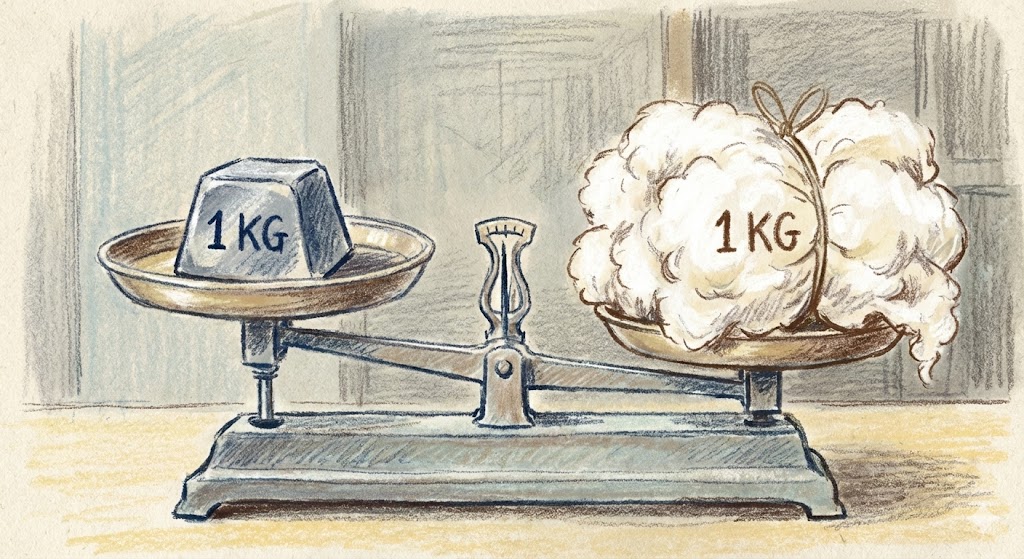
This is actually a clever question!
Now, some implicit assumptions have to be disclosed. We are talking about the weight of, say a block of lead vs. the weight of say, a bundle of cotton, on the surface of the earth.
The answer is that the cotton is heavier, in reality.
The reason is that these two objects have dramatically different buoyancy in air. In simple terms, air pushes “up” the lighter cotton more than the heavier lead ball. (Because both are fully immersed in the Earth’s atmosphere, they each displace an amount of air equal to their respective volumes. The buoyant force is equal to the weight of the displaced air. So, cotton experiences more buoyant force.)
When we weigh the cotton bundle to be a kilogram, we need to adjust for the buoyant force, which makes it seem lighter than it actually is. This adjustment applies to lead also, but to much smaller extent. So, the cotton bundle will turn out to be a wee bit more than 1kg in actual terms (when weighed in vacuum) than the lead ball.
Leave a Reply