Category: Science

  • Taste and Flow

    Quite by random accident I am in the middle of two classic books:- “Flow: The Psychology of Optimal Experience” by Mihály Csíkszentmihályi and “Zen and the Art of Motorcycle Repair: An Enquiry into Values” by Robert M. Pirsig. A moment’s reflection will quickly reveal the easy connection between the two: motorcycle repair for the enthusiast can indeed be a Flow experience. But I realized that the connection is a bit deeper.

    At first I couldn’t quite understand and hence agree with the “Quality” thing that Pirsig keeps going on and on about. But, I am starting to think he is talking about what is today fashionable among certain intellectual circles to call “taste”. As in, so and so has good taste in AI model architecture research, or investing thesis and so on. Both concepts get at an (as yet) undefined element that certain extraordinary people posses or can access, that leads to breakthroughs. Others, even experts, can do really good work, but either that work goes waste or is derivate or incremental in nature.

    Both authors talk about “care” as an essential element, both to achieve a Flow state in one’s work as well to produce work with Quality. One needs to care to do anything worthwhile. When something is done with care it shows. Sounds obvious. But is lamentably rare.
  • The Gene: An Intimate History by Siddhartha Mukherjee

    Mukherjee is a gifted writer, apart from being a real doctor. This fluent understanding of the subject matter combined with a superb story-telling ability has enabled him to write a book that’s almost un-put-downable, despite being so technical and potentially dry. 

    It’s a chronological story of the discovery of genes, genetics to gene-therapies, interwoven with some of the author’s personal family history. Like any good story teller, the author zooms in to human details in each anecdote he narrates, even ones about something as mundane as a scientific conference. Some of his personal commentary and insights are sprinkled gently throughout the narrative, enough to give it a personal touch, but not so much as to make it an opinion piece. 

    I always find the history of a science compelling, even necessary for me to appreciate the science itself, and this book fulfilled that in spades for me. 

  • The mystery of convenient Road Debris

    The mystery of convenient Road Debris

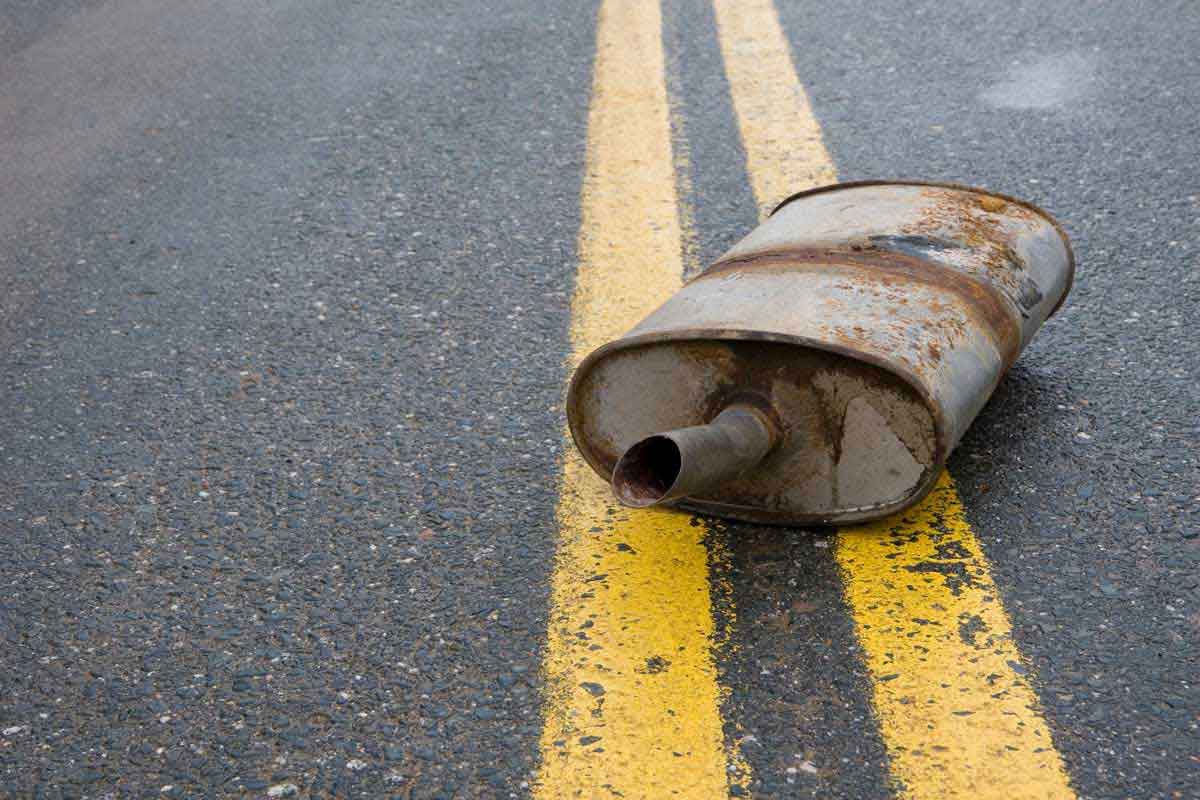
    Have you noticed that most of the time, debris fallen on a busy freeway is nicely positioned away from the middle of lanes and more or less on the dividing line/buttons? (This is true unless it’s a big object or if it has fallen off very recently.)

    This is convenient, because, traffic doesn’t have to swerve to avoid them. But from a pure probability stand-point, it’s impossible that a majority of objects that fall off vehicles going at high speeds land at such a convenient place. Perhaps there is an intelligent entity, a benevolent force, guiding this?

    If you didn’t get my drift, this sounds like the ‘intelligent design’ argument.

    I think that the reason for this phenomenon is simply this: the object initially will land most likely in the middle of a lane. Then a vehicle will hit it and it will be moved. Then another vehicle will hit it, and it’ll be moved again. And so on. This will continue randomly until the object accidentally comes to rest at a harmless location, which looks miraculously convenient.

    We could say the object’s position evolved to perfection!

  • River out of Eden : Richard Dawkins

    This was my first Dawkins (I discovered this book 8 years ago, read half of it and forgot about it. I dug it up again last week and read it through). What a shame – I have spent all these years in ignorance 🙁

    Very educational, very entertaining and extremely readable.

    This is really 5 essays on evolution in the form of a book. To be sure Dawkins builds on the ideas developed in the first chapter in the later ones, but still each can stand on its own.

    The first chapter lays down the basics about the nature of DNA and it’s propagation (DNA’s digital nature, how heredity works, etc.)

    The second discusses the “out of Africa” theories of human evolution. The discussion of the Mitochondrial Eve is fabulous.

    The third chapter’s purpose “is to destroy the argument that complicated contrivances have to be perfect if they are to work at all” – a favorite position of creationists. Brilliantly argued. Case closed!

    The fourth chapter is the best: “God’s Utility Function” – what’s the “designer” of life (on Earth) maximizing? It can’t be the “greatest good for the greatest number” – clearly there are lifeforms hurting other lifeforms for the purpose of simply existing. Or is he trying to maximize David Attenborough’s TV ratings?! More serious questions like, “it makes no economic sense in many species for the sex ratio to be 50%, when a majority of males simply consume resources and have no role to play in reproduction. why have they not been selected out?” Read the book to get the answers 🙂 It’s worth it.

    To me, the last chapter is the least best; I admit I rushed through it a bit. Dawkins tries to come up with a generalized recipe for the evolution of intelligent life on any given planet – in terms of the thresholds that need to be crossed to achieve that. It’s a little hard to follow. May be I’ll re-read it soon.

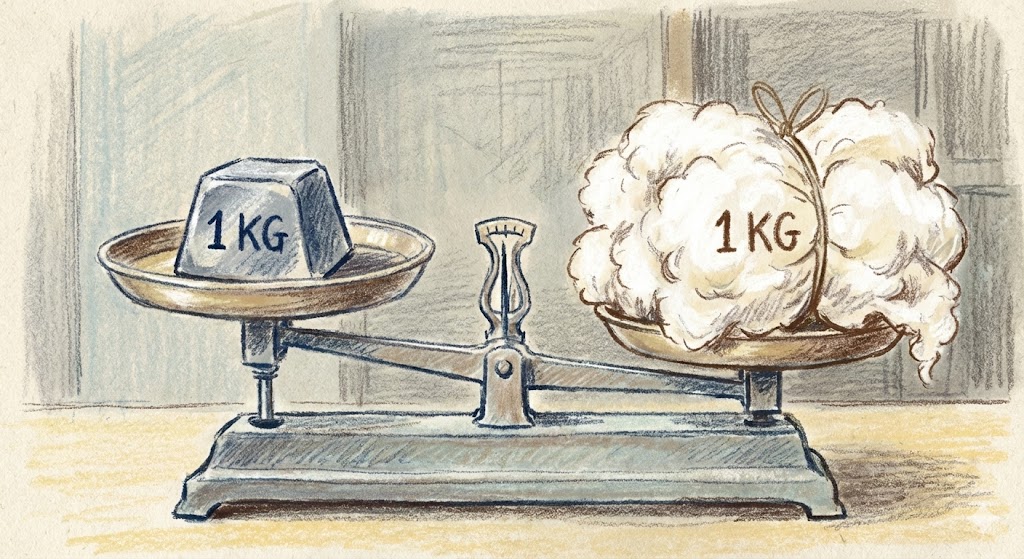
  • What’s heavier: a kg of lead or a kg of cotton?

    What’s heavier: a kg of lead or a kg of cotton?

    This is actually a clever question!

    Now, some implicit assumptions have to be disclosed. We are talking about the weight of, say a block of lead vs. the weight of say, a bundle of cotton, on the surface of the earth.

    The answer is that the cotton is heavier, in reality.

    The reason is that these two objects have dramatically different buoyancy in air. In simple terms, air pushes “up” the lighter cotton more than the heavier lead ball. (Because both are fully immersed in the Earth’s atmosphere, they each displace an amount of air equal to their respective volumes. The buoyant force is equal to the weight of the displaced air. So, cotton experiences more buoyant force.)

    When we weigh the cotton bundle to be a kilogram, we need to adjust for the buoyant force, which makes it seem lighter than it actually is. This adjustment applies to lead also, but to much smaller extent. So, the cotton bundle will turn out to be a wee bit more than 1kg in actual terms (when weighed in vacuum) than the lead ball.